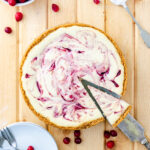
CRANBERRY SWIRL CHEESECAKE
This is a simple cranberry cheesecake recipe with a made-from-scratch buttery graham cracker crust, creamy cheesecake filling, and a tart cranberry swirl topping.
Servings: 12 slices
Calories: 543kcal
Equipment
Ingredients
For the Graham Cracker Crust:
- 1 ½ cups graham cracker crumbs 170 grams*or 10 graham cracker sheets
- pulverized into crumbs in a food processor
- 2 tablespoons granulated sugar
- 1 tablespoon brown sugar light or dark
- 7 tablespoons salted butter melted (unsalted works, too)
For the Cranberry Sauce:
- 1 ½ cups fresh or frozen cranberries
- ½ cup granulated sugar
- ¼ cup Chambord raspberry liqueur
- 3 tablespoons water
For the Filling:
- 32 ounces cream cheese bricks softened to room temperature (910 grams)
- 1 cup granulated sugar 200 grams
- ⅔ cups sour cream or plain Greek yogurt 160 grams, at room temperature
- 1 ½ teaspoons vanilla extract
- ⅛ teaspoon sea salt
- 4 large eggs room temperature
Instructions
- Prepare the crust. Preheat the oven to 325F. In a medium bowl, combine the graham cracker crumbs, granulated sugar, brown sugar, and melted butter. Stir to evenly distribute to form a wet sand texture. Pour the graham cracker mixture into a 9-inch springform pan. Press the mixture down firmly and evenly along the bottom and outer edge to form a uniform crust. Note: The bottom of a measuring cup is a useful tool for pressing.
- Make the cranberry sauce. In a small pot, combine the cranberries, sugar, Chambord, and water and bring to a boil. Cook on high heat until the cranberries pop and the mixture thickens into a syrupy consistency, about 6 minutes. Set aside to cool for 20 minutes then process until smooth in a blender or food processor, about 1 minute.
- Make the cheesecake mixture. In a bowl of a stand mixer fitted with a paddle attachment or in a large bowl (using a hand mixer) add the cream cheese and slowly beat just until smooth and creamy, scraping if needed with a spatula. Add the sugar and mix again to combine. Add the sour cream, vanilla extract, and salt. Stir on low to combine, scraping down the sides and bottom of the bowl. With the mixer on low, gradually add eggs, incorporating one at a time just until fully incorporated to avoid over-mixing.
- Bake the cheesecake. Set the prepared springform pan on top of a baking tray to protect the oven from leaks. Pour the cheesecake mixture into the graham cracker crust. Add a few swirls: Spoon cranberry mixture over filling and drag the tip of a knife shallowly to create a marbled effect. Bake on the center rack until the edges appear lightly browned and the center springs back when lightly touched (note: it will still be wobbly or jiggly like Jello in the very center–the internal temperature should be 140-150F), begin checking at 1 hour.
- Cool and chill the cheesecake. Allow the cheesecake to cool for 10 minutes on top of the stove-top then use an offset spatula to gently loosen the crust from the inside of the springform pan (this helps prevent cracks as your cheesecake cools and shrinks). After a complete cool-down period (usually 1-2 hours or until near room temperature), cover with plastic wrap and transfer to the refrigerator to cool overnight or for at least 6 hours.
Notes
4 Tips to avoid cosmetic surface cracks:
1) Set out the cold ingredients (cream cheese, sour cream, eggs) a couple hours in advance.
2) Avoid over-mixing ingredients, which causes extra air to beat into the cheesecake mixture.
3) Allow for a more gradual cool-down period using the hot oven. Rest the cheesecake on the stove-top (which is going to remain hot, slowing down the cooling process).
4) Separate the crust from the springform pan with an offset spatula (as it cools, it will shrink and pull away from the pan).
Nutrition
Serving: 1slice | Calories: 543kcal | Carbohydrates: 44g | Protein: 7g | Fat: 38g | Saturated Fat: 21g | Polyunsaturated Fat: 2g | Monounsaturated Fat: 10g | Trans Fat: 0.3g | Cholesterol: 163mg | Sodium: 397mg | Potassium: 160mg | Fiber: 1g | Sugar: 36g | Vitamin A: 1388IU | Vitamin C: 2mg | Calcium: 106mg | Iron: 1mg